


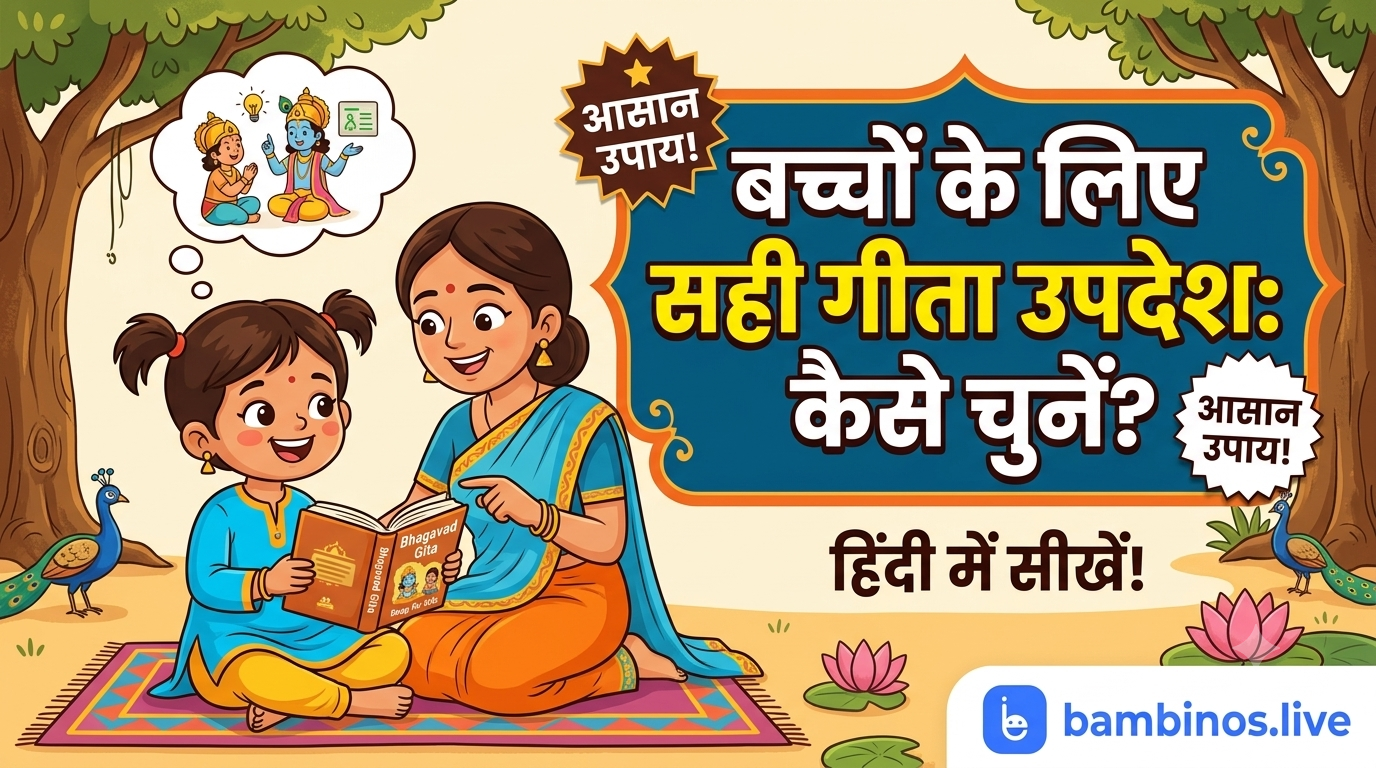
Parents can choose the right Gita teachings in Hindi for kids by considering their age, understanding, language comfort and everyday challenges. Younger children benefit from stories and simple values, while older children can explore duty, self-control and decision-making. Choose lessons that explain meanings clearly and connect teachings with daily life.
Many parents want their children to understand the Bhagavad Gita but are unsure where to begin. A four-year-old cannot engage with duty, emotions or consequences in the same way as a teenager preparing for examinations. Language can create another concern, particularly when children understand conversational Hindi but are unfamiliar with philosophical vocabulary.
Choosing geeta teachings in hindi becomes easier when parents start with the child's age and experiences rather than trying to cover too many verses or ideas at once. Structured bhagavad gita online classes can also give families access to guided discussions, stories and explanations from home.
Bambinos.live offers a Bhagavad Gita course for children that parents can consider when looking for structured values and cultural learning. This blog article explains how to select teachings by age, how learning can change as children grow and how Bambinos.live can fit into a parent's decision.
What should parents consider when choosing Gita teachings in Hindi for kids?
Parents should consider the child's age, Hindi comprehension, attention span, interests and current challenges when choosing bhagavad gita teachings in hindi. The teaching should explain ideas through situations children recognise. Younger learners need simple stories and values, while older children can discuss responsibility, emotions, effort and decision-making in greater depth.
The goal should be understanding rather than introducing the largest possible number of teachings.
Start with a value the child can recognise
Children usually understand an idea more easily when it relates to something they experience.
For example:
-
Self-control: waiting before reacting when angry
-
Responsibility: completing an agreed task
-
Focus: giving attention to homework without constant distractions
-
Courage: admitting a mistake
-
Respect: listening during disagreements
-
Effort: preparing sincerely without worrying constantly about results
-
Thoughtful choices: considering consequences before acting
Parents searching for geeta teachings in hindi may also ask, “बच्चों के लिए गीता की मुख्य शिक्षाएँ क्या हैं?” when looking for simple explanations that connect values with children's lives.
Similarly, parents researching gita teachings in hindi, teachings of geeta in hindi or teachings of gita in hindi can begin with everyday ideas before moving towards more philosophical discussions.
A structured Bhagavad Gita program for kids can introduce values through stories, selected verses and questions rather than expecting children to interpret complex passages independently.
Consider the child's Hindi ability
Being able to speak Hindi conversationally does not necessarily mean a child will immediately understand philosophical vocabulary.
Bhagavad gita teachings in hindi can introduce ideas such as कर्म, आत्म-नियंत्रण, धैर्य और जिम्मेदारी through examples children recognise from everyday life.
Parents interested in bhagwat geeta teaching in hindi should check how unfamiliar words are explained. Simple Hindi, examples and opportunities to ask questions can make concepts more accessible.
For children who are more comfortable learning in English, Bhagavad Gita in English for students can offer another route to understanding the concepts. Parents can still introduce selected Hindi or Sanskrit terms gradually.
Choose understanding before memorisation
Memorising a verse and understanding its meaning are different learning goals.
Bhagavad Gita learning can include shlokas, but children should also have opportunities to ask what a teaching means and where they might encounter the underlying idea in their own lives.
Teachings of geeta in hindi can be easier for children to understand when teachers explain श्लोक का अर्थ और जीवन में उसका उपयोग rather than concentrating only on memorisation.
For example, a lesson about effort becomes more relevant when connected with a test, sports competition or performance rather than presented only as an abstract principle.
Match the format with the learning goal
A Bhagavad Gita course for kids may follow a structured curriculum, while Bhagavad Gita lessons for kids may focus on particular stories, verses or values. A Bhagavad Gita course for children should also explain what children are expected to learn as they progress.
Parents considering Online Bhagavad Gita classes for kids or Online Bhagavad Gita classes for children should check whether lessons are interactive. Children need opportunities to answer, question and discuss rather than simply listen.
The same principle applies to Bhagavad Gita classes for kids online and Bhagavad Gita classes for children online. The course name matters less than what actually happens during a lesson.
How should Gita learning change for children from ages 4 to 15?
Gita learning should become progressively deeper from ages 4 to 15. Children aged 4–6 need stories, simple values and short activities; ages 7–12 can discuss choices, effort and responsibility; teenagers can explore emotional balance, duty and decision-making. Age should guide teaching style, but previous knowledge matters too.
Parents comparing bhagavad gita online classes should therefore look for programmes that adapt explanations rather than giving every age group identical lessons.
Ages 4 to 6: introduce simple ideas through stories
At four, five and six, children generally benefit from concrete examples.
Bhagavad Gita online classes for 4 year olds, Bhagavad Gita online classes for 5 year olds and Bhagavad Gita online classes for 6 year olds can focus on values such as kindness, patience, listening, honesty and responsibility.
Likewise, a Bhagavad Gita online program for 4 year olds, Bhagavad Gita online program for 5 year olds or Bhagavad Gita online program for 6 year olds should keep activities manageable for younger attention spans.
A Bhagavad Gita program for young learners or Bhagavad Gita classes for young learners can use stories, questions and simple situations to introduce ideas without expecting children to analyse philosophy.
Ages 7 to 9: connect teachings with choices
Children at this stage can begin discussing why a particular action might be thoughtful, fair or responsible.
Parents may explore:
-
Bhagavad Gita online classes for 7 year olds and a Bhagavad Gita online program for 7 year olds
-
Bhagavad Gita online classes for 8 year olds and a Bhagavad Gita online program for 8 year olds
-
Bhagavad Gita online classes for 9 year olds and a Bhagavad Gita online program for 9 year olds
At these ages, Bhagavad Gita lessons for children can use situations such as losing a game, arguing with a sibling, completing homework or sharing responsibility in a group.
A Bhagavad Gita learning program for kids can also introduce simple reflection by asking children what they would do in a familiar situation and why.
Families researching gita teachings in hindi often want to know “बच्चों को भगवद गीता कैसे सिखाएँ?” A suitable answer at this age is to connect each teaching with a choice the child already understands.
Ages 10 to 12: introduce reflection and consequences
Children aged 10 to 12 can usually examine motivations, actions and consequences in greater depth.
Bhagavad Gita online classes for 10 year olds, Bhagavad Gita online classes for 11 year olds and Bhagavad Gita online classes for 12 year olds can introduce discussions about focus, effort, responsibility, comparison and managing emotions.
Similarly, a Bhagavad Gita online program for 10 year olds, Bhagavad Gita online program for 11 year olds or Bhagavad Gita online program for 12 year olds can encourage children to connect teachings with school, friendships and family responsibilities.
A Bhagavad Gita learning program for children at this stage can include questions that require reflection rather than answers based entirely on memory.
Ages 13 to 15: connect teachings with teenage challenges
Teenagers face more complex choices involving friendships, academic expectations, competition, identity, independence and future goals.
Bhagavad Gita online classes for 13 year olds, Bhagavad Gita online classes for 14 year olds and Bhagavad Gita online classes for 15 year olds can explore these situations through more mature discussions.
A Bhagavad Gita online program for 13 year olds, Bhagavad Gita online program for 14 year olds or Bhagavad Gita online program for 15 year olds should allow teenagers to question ideas and form thoughtful interpretations.
Bhagavad Gita classes for teens and a Bhagavad Gita program for teens can focus on applying ideas rather than presenting teenagers with activities designed for younger children.
This makes bhagavad gita for teens particularly relevant to discussions around pressure, effort, emotions and decision-making.
Parents exploring teachings of gita in hindi for teenagers may be looking for discussions around पढ़ाई का दबाव, क्रोध पर नियंत्रण, सही निर्णय और अपने कर्म पर ध्यान. These themes are easier to explore when teenagers are encouraged to question and discuss rather than simply memorise.
Should children learn in Hindi or English?
The language should allow children to understand concepts and ask questions comfortably.
Teachings of geeta in hindi and teachings of gita in hindi may work well for children who understand Hindi comfortably. Bhagwat geeta teaching in hindi should still explain unfamiliar philosophical terms rather than assuming children already know them.
For children who understand complex ideas more easily in English, Bhagavad Gita in English for students can be considered. A teacher can introduce a Sanskrit shloka and then discuss its meaning in the language the child understands best.
This flexibility can make the teachings more accessible without turning unfamiliar vocabulary into a barrier.
How can Bambinos.live introduce Gita teachings to kids and teens?
Bambinos.live can introduce children to Bhagavad Gita learning through its structured Bhagavad Gita programme. Parents can consider the course according to their child's age, interests and readiness for values-based discussions. The relevant choice should match the child's ability to understand stories, shlokas, meanings and their connection with everyday situations.
Parents exploring Bambinos.live alongside other bhagavad gita online classes should focus on what they want their child to gain from the learning experience.
Look at the learning goal first
A parent may want a young child to become familiar with simple values and stories. Another family may want an older child to think more deeply about responsibility, focus, emotions or choices.
This is why a Bhagavad Gita program for kids should be considered according to the child's stage rather than the programme name alone.
Similarly, a Bhagavad Gita program for children should make complex concepts understandable without expecting children to approach the text as adults would.
For teenagers, a Bhagavad Gita program for teens can be more relevant when discussions connect ideas with academic pressure, friendships, effort, self-control and decision-making.
Consider the learning format
Parents familiar with Online classes for kids may already know that live digital learning works best when children actively participate.
An Online Bhagavad Gita program for kids or Online Bhagavad Gita program for children should give children space to listen, respond and reflect. The same applies to a Bhagavad Gita online program for kids and Bhagavad Gita online program for children.
For younger pupils, interaction may involve stories and simple questions. Older children can discuss motives, consequences and different ways of responding to a situation.
A child-friendly approach to bhagwat geeta teaching in hindi should answer practical questions such as “गीता बच्चों को क्या सिखाती है?” through stories, discussions and familiar situations.
Look for progression as the child grows
A Bhagavad Gita program for young learners should begin with ideas children can recognise. As children become older, the learning can gradually include deeper discussions.
A Bhagavad Gita learning program for kids may introduce values through stories, while a Bhagavad Gita learning program for children can gradually encourage greater reflection.
For teenagers, bhagavad gita learning can involve questions about what they can control, how they respond to setbacks and how they make decisions under pressure.
Parents interested specifically in bhagavad gita teachings in hindi or gita teachings in hindi should review the language used in the programme and whether it matches their child's comprehension. If Hindi is not the child's strongest language, understanding the meaning should remain the priority.
Bambinos.live can therefore be considered as one option for families looking for structured Bhagavad Gita learning, with the final decision based on the child's age, interests, language comfort and learning goals.
How can parents choose the right Gita learning path for their child?
By now, you can see that choosing the right Gita learning path depends on age, language comfort, learning goals and the child's ability to reflect. Start by deciding whether you want your child to understand values, explore stories, learn selected shlokas or discuss how Bhagavad Gita ideas relate to everyday choices.
For younger children, Online Bhagavad Gita classes for kids and Online Bhagavad Gita classes for children should use simple explanations and familiar examples. A Bhagavad Gita program for young learners should introduce ideas gradually.
Parents can also compare a Bhagavad Gita online program for kids, Bhagavad Gita online program for children, Online Bhagavad Gita program for kids and Online Bhagavad Gita program for children according to curriculum, interaction and age grouping.
A Bhagavad Gita learning program for kids or Bhagavad Gita learning program for children should make its learning objectives understandable to parents. For older learners, Bhagavad Gita classes for teens should allow more questioning and reflection.
If Hindi is central to your goal, examine how bhagavad gita teachings in hindi, gita teachings in hindi, teachings of geeta in hindi, teachings of gita in hindi and bhagwat geeta teaching in hindi are presented. The child should be able to understand the idea rather than simply repeat unfamiliar vocabulary.
Bambinos.live can be considered by families looking for structured Bhagavad Gita learning for children. Compare the course objectives and teaching approach with your child's current needs before choosing.
A suitable programme should leave children with more than remembered verses. They should gradually recognise values, discuss what those values mean and consider how they can apply them to their own choices. Book a demo
Frequently asked questions
1. What Gita teachings should young children learn first?
Young children can begin with simple ideas such as kindness, patience, responsibility, honesty and self-control. Stories and everyday examples can make these concepts easier to understand before children explore more complex philosophical ideas.
2. Can a four-year-old learn the Bhagavad Gita online?
A four-year-old can begin through short stories, simple values and interactive activities. Bhagavad Gita online classes for 4 year olds and a Bhagavad Gita online program for 4 year olds should use brief, concrete explanations rather than abstract discussions.
3. Should children learn Bhagavad Gita teachings in Hindi or English?
Children should learn in the language that allows them to understand concepts and ask questions comfortably. Hindi may suit some families, while English may suit others. Sanskrit shlokas can still be introduced alongside explanations in the child's stronger language.
4. How should Bhagavad Gita learning change for teenagers?
Teenage learning should include deeper discussion about responsibility, academic pressure, emotions, relationships, effort and decision-making. Teenagers can question and interpret ideas more independently than younger children, so lessons should give them room for thoughtful discussion.
5. Are online Bhagavad Gita programmes suitable for beginners?
Online programmes can suit beginners when teachers introduce the background, vocabulary, stories and ideas gradually. Parents should check whether the programme assumes previous knowledge and whether the teaching language matches the child's comprehension.
6. Does Bambinos.live offer a Bhagavad Gita programme for kids?
Bambinos.live offers a Bhagavad Gita programme for children. Parents can review its current curriculum, teaching approach, class format and learning objectives to decide whether these match their child's age and learning goals.
7. How should parents decide whether Bambinos.live is suitable for their child?
Parents should compare the Bambinos.live Bhagavad Gita programme with their child's age, language comfort, interests and learning goals. They should consider the course structure and teaching approach, particularly whether these align with what they want their child to understand and apply.




 English
 Indonesia
 Arabic
 French
 Spanish
 Portuguese
 Turkish
 Dutch
Dutch
 Italiano
 Russian
 Romaian
 Portuguese (Brazil)
 Greek
Greek